LEVEL B1 - INTERMEDIATE
WHAT TO EXPECT AT LEVEL B1 AT THE LISBON LANGUAGE CAFÉ?
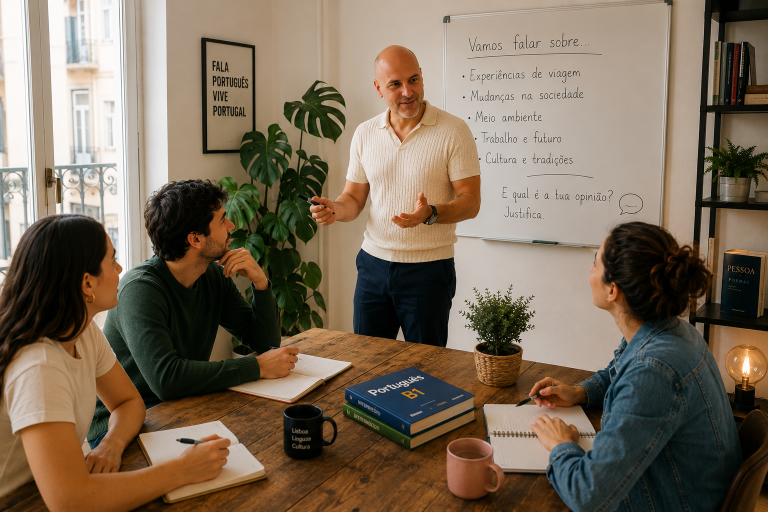
Our B1-level classes focus on structured conversations with well-defined goals. While speaking in Portuguese is important for skill reinforcement, it’s crucial to ensure that the conversation is planned and structured and that grammatical objectives are clearly set by the teacher. Typically, 80-90% of class time is devoted to structured conversation activities, while the remaining 10-20% is used to address grammar concerns or questions. Merely engaging in Portuguese conversation without clear goals is not enough.
To acquire and solidify knowledge at the B1 level, students will participate in conversation classes with carefully selected activities and clearly defined grammatical goals. During these conversations in Portuguese, the teacher will guide students toward the correct grammatical structures. The grammatical concepts are studied at home and their solidification and clarification are completed during class time. This approach allows for more time to engage in conversation during class.
During the lessons, the focus is on conversation, while grammar is covered at home through recorded video lessons. This approach gives students significantly more time to practise speaking and develop confidence in real-life communication.
LEVEL B1 - FAQ's
It’s challenging to accurately estimate the number of hours needed to reach B1 proficiency. It varies greatly based on each student’s abilities and aptitudes. However, as a rough approximation, it usually takes about 80 hours to acquire and solidify B1-level knowledge in Portuguese.
Yes, completing homework is essential for solidifying proficiency at the B1 level in Portuguese. The grammatical concepts covered at this level are initially studied at home and then further clarified during class. From this level on, it is also essential for students to regularly speak with native speakers. Only through consistent exposure to the language will students be able to consolidate the grammatical structures and conjunctions learned during levels A1 and A2. These conversation activities with native speakers should be considered an integral part of the B1-level students’ homework.
At the end of level B1, students have the ability to converse with natives in one-to-one situations comfortably. However, if speaking with someone with a strong Portuguese accent or someone who speaks very fast, difficulties may still be encountered.
It is important to note, however, that in group conversations, students will still experience difficulties in actively and comfortably participating in the conversation. A group conversation in a restaurant with a group of Portuguese speakers is a challenge that only B2-C1 level students will be able to successfully tackle. Be patient, learning Portuguese (or any other language) takes time.
PORTUGUESE, LEVEL B1 – PROGRAMME OF STUDIES
- UNIT 1: A. Simple past-perfect past tense (pmqps) B. Past tense more than perfect Composite of the indicative (pmqpc) C. Passive voice [action (verb to be) and state (verb to be)]
- UNIT 2: A. Present perfect compound (PPC) B. Placement of Pronouns in compound tenses
- UNIT 3: A. Indicative and subjunctive B. Formation of the Present in the subjunctive (Expression of the concession)
- UNIT 4: A. Subjunctive Present (time expression and Condition expression) B. Prepositions
- UNIT 5: A. Subjunctive Present (concessive alternation and hypothetical eventuality) B. Portuguese Proverbs
- UNIT 6: A. Indicative mode vs Subjunctive mode B. Personal infinitive or subjunctive C. Verbs with prepositions
- UNIT 7: A. Future of subjunctive B. Direct speech / Indirect speech
- UNIT 8: A. Imperfect subjunctive Present vs Imperfect subjunctive
B1+ - CONVERSATION LESSONS
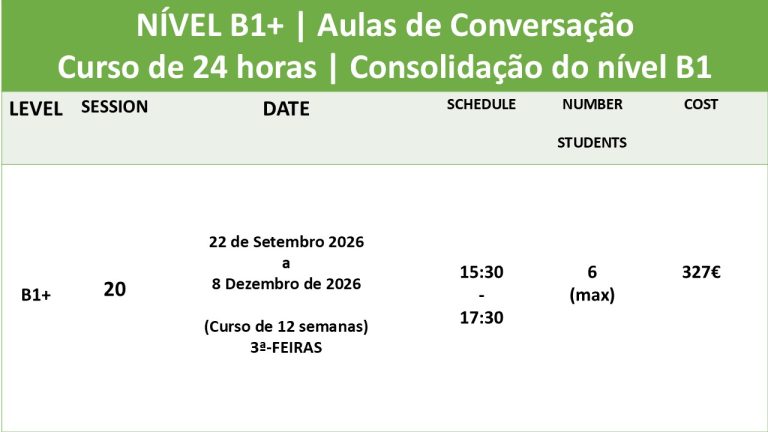
The B1 Conversation Course is designed for students who have completed Level B1 and wish to consolidate everything they have learned. As the name suggests, these are conversation-focused classes built around the grammatical structures from the first three levels (A1, A2, and B1). Grammar is reviewed and reinforced naturally as conversations unfold and questions arise. In our advanced groups, the B1+ course helps students consolidate the structures learned at A1, A2, and B1 levels while introducing key B2-level structures that support continued progress towards advanced proficiency.